Crooked Carrots, Straight Priorities: How Food Co-ops Are Transforming Discarded Produce Into Community Capital
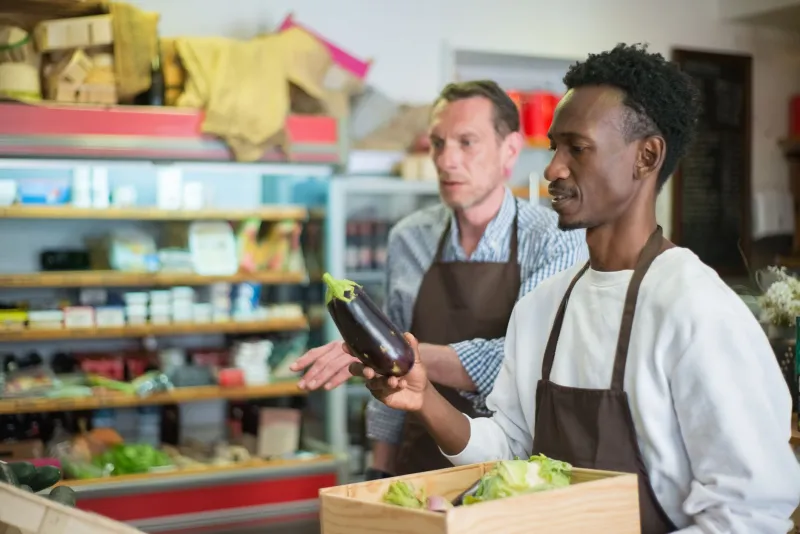
There is nothing wrong with a knobby potato. It boils the same, nourishes the same, and feeds a family just as completely as its unblemished counterpart sitting in a supermarket bin. Yet somewhere between the farm and the checkout counter, conventional grocery logistics quietly discard an enormous share of the American harvest — not for safety reasons, but for aesthetics. The result is a food system that generates staggering waste while millions of households struggle to afford fresh vegetables.
A growing number of food cooperatives across the United States are treating this contradiction not as an unfortunate market externality, but as an organizing opportunity. By systematically intercepting produce that corporate supply chains reject, these member-owned grocers are constructing what practitioners have begun calling "surplus loops" — circular economic arrangements that turn the throwaway logic of industrial food into a source of local employment, affordable nutrition, and shared community wealth.
The Architecture of Waste
To understand what cooperatives are challenging, it helps to understand the scale of what gets discarded. The Natural Resources Defense Council has estimated that roughly 40 percent of food produced in the United States never gets eaten. A significant portion of that loss occurs at the farm and distribution level, where produce is culled for failing to meet retailer specifications — specifications that have far more to do with visual uniformity than nutritional value or food safety.
Conventional supply chains are built around the assumption that consumers will reject irregular produce. Retail contracts often enforce strict cosmetic grading standards, meaning farmers frequently have no economically viable channel for the portion of their harvest that is nutritious but visually imperfect. Some of that food gets composted or plowed under. Some is left in the field. The remainder, if farmers are fortunate, reaches food banks — though donation logistics are inconsistent and often inadequate.
Cooperative grocery networks are inserting themselves at precisely this juncture, building the infrastructure that conventional markets never bothered to create.
The Surplus Loop in Practice
The operational model varies by region and cooperative structure, but the core logic is consistent. A co-op — or a consortium of co-ops coordinating through a regional network — establishes direct purchasing agreements with local and regional farms for their "seconds": the produce graded out of conventional retail channels. That produce is then sorted, packaged, and sold to members and the broader community at a meaningful discount from standard retail prices.
What makes this arrangement genuinely cooperative rather than simply thrifty is the labor and governance structure surrounding it. Sorting and packing operations are frequently staffed by workers drawn from the same food-insecure communities the program serves, creating employment with living wages and, in some cases, pathways to worker-ownership. Member households — particularly those enrolled in income-scaled membership tiers that many co-ops now offer — gain reliable access to affordable fresh produce that would otherwise be unavailable at their price point.
The Seward Community Co-op in Minneapolis, long regarded as one of the more sophisticated models of urban cooperative grocery, has incorporated surplus produce sourcing into its broader commitment to local food system investment. Similarly, the Weaver Street Market cooperative in North Carolina has developed regional sourcing relationships that prioritize capturing the portion of harvests that would otherwise be lost. These are not charity programs. They are designed as economically self-sustaining operations in which the co-op, the farmer, the worker, and the consumer all derive tangible benefit.
Why Cooperative Governance Makes the Difference
A reasonable question is why conventional grocery chains — some of which have launched their own "imperfect produce" marketing initiatives — have not solved this problem at scale. The answer lies in the structural incentives that cooperative governance creates versus those that shareholder primacy demands.
For a publicly traded retailer, a discounted produce line competes with existing margin on standard inventory. Sourcing relationships with dozens of small and mid-sized regional farms are logistically complex compared to a single national distributor contract. The return on investment is uncertain. When quarterly earnings are the organizing metric, the calculus consistently favors simplicity over community benefit.
A cooperative operates under a different mandate. Its members are not seeking maximum return on invested capital — they are seeking maximum benefit from their collective purchasing power, their shared values, and their stake in the health of the surrounding community. A surplus loop program that breaks even while reducing neighborhood food insecurity and creating local jobs is not a marginal outcome for a cooperative; it is the point.
Board members at member-owned grocers are accountable to the people eating the food and living in the neighborhood, not to institutional investors in another city. That accountability difference is not cosmetic. It shapes every procurement decision, every labor policy, and every community partnership the organization pursues.
Scaling the Loop
Perhaps the most promising development in this space is the emergence of inter-cooperative coordination. Individual co-ops have limited purchasing volume, which can make it difficult to absorb the irregular supply flows that characterize farm surplus. When cooperatives pool their sourcing through regional food co-op federations or informal purchasing alliances, they gain the collective scale to make consistent commitments to farmers — commitments that make surplus capture economically rational for the farm as well.
The National Cooperative Grocers association, which represents independent food co-ops across the country, has increasingly supported member stores in building these kinds of regional sourcing networks. The logic is straightforward: a single co-op buying surplus from a farm provides modest relief; a network of fifteen co-ops making coordinated purchases creates a genuine secondary market that farmers can plan around.
Some cooperatives are extending the loop further still. Produce that is too damaged even for discounted direct sale can be routed to cooperative-affiliated food processing operations — community canneries, cooperative fermentation projects, or shared commercial kitchens where value-added products are made and sold. In this way, the surplus loop becomes genuinely circular, with near-zero waste and value created at every stage.
Nutrition, Dignity, and the Economics of Enough
There is a dimension to this work that transcends the operational. Food insecurity in the United States is not primarily a problem of insufficient food production. It is a problem of distribution, pricing, and political will. When a cooperative builds a surplus loop, it is not merely solving a logistics puzzle — it is making a concrete argument about what the food system should value.
The argument is this: that a knobby carrot has the same right to nourish a person as a perfectly tapered one. That the labor of sorting and packing deserves fair compensation. That a community's collective purchasing power is a form of wealth that can be organized deliberately, rather than simply surrendered to supply chains designed elsewhere.
Food cooperatives practicing surplus capture are not waiting for federal policy to realign incentives or for corporate retailers to discover their conscience. They are building the alternative now, one imperfect apple at a time — and demonstrating, in the process, that the most efficient food system is not the one that moves product fastest, but the one that wastes the least and shares the most.