Raising Children Together: The Quiet Revolution of Parent-Run Childcare Cooperatives
For most American families, the cost of childcare is not merely an inconvenience — it is a structural crisis. According to the Economic Policy Institute, the average annual cost of center-based infant care in the United States exceeds $17,000, surpassing the cost of in-state college tuition in many states. For working parents in cities like Boston, Seattle, or Chicago, that figure climbs considerably higher. The market, left to its own devices, has produced a system that extracts wealth from families at the very moment they are most financially and emotionally vulnerable.
But in communities from Portland, Oregon, to Providence, Rhode Island, a different model is quietly taking root — one that does not treat the care of young children as a commodity to be priced and sold, but as a shared social responsibility to be organized collectively.
What a Childcare Cooperative Actually Looks Like
At its most fundamental level, a childcare cooperative is a group of families who pool their time, resources, and expertise to care for one another's children. Some cooperatives operate as formal legal entities — registered nonprofits or worker-owned structures — while others function as informal neighborhood arrangements built entirely on trust and reciprocity. What unites them is a rejection of the transactional logic that governs conventional childcare markets.
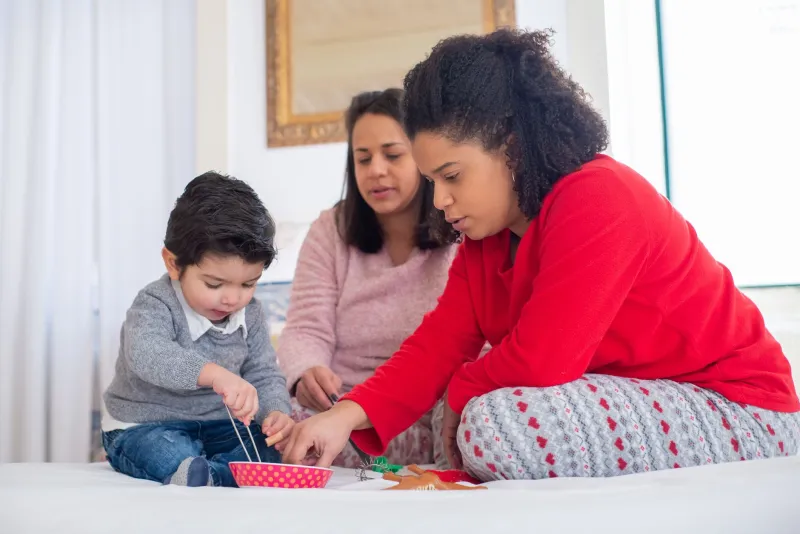
In a typical parent-run cooperative, each participating family contributes a defined number of hours per month as a caregiver, attends governance meetings, and shares in administrative responsibilities such as scheduling and safety planning. Children receive care in rotating home settings or in a shared community space, often a church basement, a community center, or a collectively leased storefront. Costs are dramatically reduced because labor — the single largest expense in any childcare operation — is contributed by the families themselves rather than purchased on the open market.
Some cooperatives go further, hiring one or two professional early childhood educators to provide pedagogical consistency and credentialed oversight while still relying on parent participation to keep overall costs low. This hybrid approach has proven particularly effective in communities where families want professional educational programming without surrendering democratic control over how their children are raised.
The Economics of Collective Care
The financial logic of cooperative childcare is straightforward, even if the mainstream childcare industry rarely acknowledges it. When families share caregiving labor equitably, they eliminate the need to generate profit for a corporate owner or return for a private investor. Overhead is distributed. Decision-making is transparent. Surpluses, when they exist, are reinvested into the cooperative itself rather than extracted.
Research published by the National Center for the Study of Privatization in Education has found that cooperative childcare arrangements can reduce per-family costs by thirty to fifty percent compared to private market alternatives, without sacrificing quality. In fact, parent-run cooperatives often demonstrate stronger child-to-adult ratios than commercial centers, precisely because caregiving hours are contributed rather than minimized to reduce payroll.
For lower- and middle-income families who have been systematically priced out of quality early childhood education, this is not a marginal improvement. It is the difference between a parent remaining in the workforce and leaving it, between a child receiving enriching care and being left in inadequate arrangements cobbled together from necessity.
Building Neighborhood Bonds, Not Just Childcare Slots
The benefits of cooperative childcare extend well beyond economics. Families who organize and govern together build something that the market cannot manufacture: genuine social trust.
Parents in cooperative networks consistently report deeper relationships with their neighbors than they experienced before joining. They learn one another's values, parenting philosophies, and life circumstances in ways that incidental proximity never produces. They navigate disagreements through structured democratic processes — a skill increasingly rare in a society accustomed to algorithmic sorting and curated social media bubbles.
Children, too, develop differently within these environments. Researchers studying cooperative early childhood settings have observed that children in parent-cooperative programs demonstrate stronger prosocial behaviors and greater comfort with diverse adult relationships than their peers in conventional commercial settings. When care is visibly communal — when children watch their own parents take turns caring for others' children — they internalize lessons about reciprocity and collective responsibility that no curriculum can fully replicate.
For many families, particularly those who are geographically distant from extended family networks, the cooperative becomes a functional substitute for the multigenerational village that American mobility and individualism have eroded. It is not hyperbole to say that these networks are rebuilding, neighborhood by neighborhood, a social fabric that the market economy has spent decades unraveling.
Scaling Without Losing the Soul
One of the central tensions facing the cooperative childcare movement is the question of scale. The very intimacy and trust that make these networks function so effectively can be difficult to preserve as they grow. A cooperative of eight families operates on fundamentally different social dynamics than one of forty.
Organizations such as the National Association of Parent Cooperative Preschools, which has supported cooperative childcare development in the United States since the 1920s, have long grappled with this question. Their answer has generally been to favor replication over expansion — encouraging the formation of new, independent cooperatives rather than the growth of any single cooperative into an unwieldy institution. This federated approach allows networks to maintain their human scale while sharing resources, training materials, and institutional knowledge across a broader ecosystem.
More recent models have explored the use of community land trusts and shared facility ownership to give cooperatives stable, affordable physical homes without becoming dependent on the whims of commercial real estate markets. In Minneapolis and Denver, cooperative childcare networks have partnered with community development organizations to secure long-term leases on publicly owned properties, insulating themselves from the gentrification pressures that have shuttered community institutions across America's urban cores.
Technology, used carefully and collectively, is also playing a role. Scheduling platforms developed cooperatively and governed by their user communities allow families to coordinate caregiving hours, track participation equity, and communicate across language barriers — without surrendering their data to a private platform optimized for profit rather than community wellbeing.
A Model That Demands More of Us — and Gives More Back
Cooperative childcare is not without its challenges. It requires time, organizational capacity, and a willingness to share governance with people whose parenting styles and values may differ from one's own. It demands that participants show up — not merely as consumers, but as co-creators of something larger than themselves.
These demands are, in a sense, precisely the point. The cooperative model asks families to resist the consumerist reflex — the instinct to purchase care rather than build it — and to invest instead in relationships of mutual obligation. That is harder than writing a check. It is also, for many participants, profoundly more meaningful.
At Mankind Cooperative, we believe that the commodification of care is not an inevitable feature of modern life but a choice — one that communities retain the power to unmake. Cooperative childcare networks are one of the clearest demonstrations that collective organization can produce outcomes that the market, for all its efficiency, is structurally incapable of delivering: affordable, values-aligned, community-embedded care for the youngest and most vulnerable members of our society.
The children being raised in these cooperatives are learning, from their earliest years, that human needs are best met not through transaction but through solidarity. That may be the most important lesson any generation could carry forward.