Planting Permanence: How Perennial Food Forests Are Replacing Charity With Community Abundance
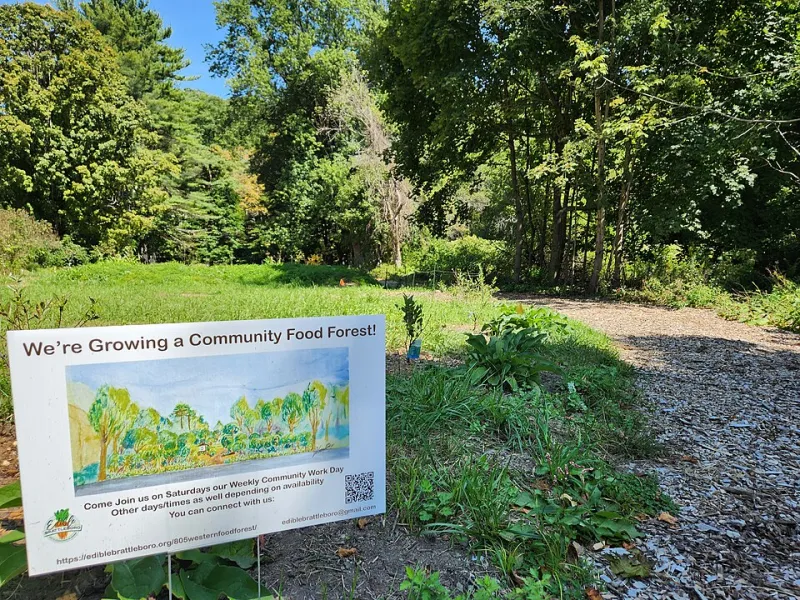
Photo: usfs_Eastern_Region, Public domain, via Wikimedia Commons
For decades, the dominant response to food insecurity in the United States has followed a familiar script: collect surplus, distribute it through a centralized facility, and repeat the cycle indefinitely. Food banks perform genuinely vital work, and no honest assessment of community hunger would dismiss their contributions. Yet the model carries an inherent limitation—it addresses the symptom rather than the system. A growing number of American neighborhoods are now asking a more ambitious question: what if communities could grow their own permanent abundance, embedded directly into the land they share?
The answer, increasingly, is the community food forest.
What a Food Forest Actually Is
A food forest is not a garden in the conventional sense. It is a deliberately designed, multi-layered ecosystem that mimics the structure of a natural woodland while maximizing edible yield. A mature food forest typically includes a canopy layer of fruit and nut trees, a sub-canopy of dwarf trees and large shrubs, a shrub layer of berry-producing plants, an herbaceous layer of perennial vegetables and medicinal herbs, a ground cover layer of edible creeping plants, a root layer of tubers and bulbs, and a vertical layer of climbing vines.
Because the system is perennial—meaning the plants return year after year without replanting—the labor and cost inputs decrease significantly over time while the ecological complexity, and therefore the yield, increases. A well-established food forest essentially feeds itself, building soil fertility, retaining water, and suppressing weeds through its own biological processes. For communities operating with limited budgets and volunteer labor, this self-reinforcing dynamic is not merely attractive; it is transformative.
Real Communities, Real Results
In Beacon Food Forest in Seattle, Washington, what began as a seven-acre city-owned hillside has become one of the largest publicly accessible food forests in the country. Launched through a community design process in 2009 and opened in phases beginning in 2012, the project now offers hundreds of varieties of edible plants—apples, Asian pears, persimmons, currants, kale, and herbs among them—freely available to any resident who visits. The forest is maintained through volunteer workdays, and the city's involvement has been instrumental in providing land tenure, a prerequisite that many similar projects struggle to secure.
In Atlanta, Georgia, the nonprofit Truly Living Well has integrated food forest principles into urban agriculture plots across several neighborhoods, emphasizing food sovereignty for communities historically excluded from both land ownership and reliable grocery access. Their approach pairs ecological design with workforce development, training residents in permaculture techniques that are immediately applicable to their own properties.
In Detroit, Michigan—a city that has confronted dramatic population loss and the resulting abundance of vacant land—community organizations have converted dozens of formerly blighted parcels into productive green spaces. Several of these sites incorporate food forest design, recognizing that perennial systems require less ongoing management than annual vegetable gardens, making them well-suited to volunteer-driven stewardship.
The Ecological Case for Collective Planting
Beyond food production, community food forests generate ecological benefits that extend well past their borders. Tree canopy reduces urban heat island effects, a concern of mounting urgency as summer temperatures in American cities climb. Root systems and ground cover absorb stormwater, reducing runoff that would otherwise carry pollutants into local waterways. Diverse plantings support pollinators, birds, and beneficial insects, strengthening the broader ecological web.
These benefits are not incidental. They represent a form of collective infrastructure investment that, unlike a road or a water main, improves with age rather than deteriorating. The community that plants a food forest today is making a gift to residents who have not yet moved to the neighborhood.
The Social Architecture of Shared Land
Perhaps the most underappreciated dimension of the food forest movement is what happens between people, not between roots and soil. Shared stewardship of a common resource requires—and therefore cultivates—communication, negotiation, and mutual accountability. Communities that build food forests together tend to report stronger social ties, reduced isolation among elderly residents, and increased civic participation.
For children in particular, regular access to a food forest offers something that neither a grocery store nor a food bank can provide: a direct, embodied understanding of where food comes from and what it takes to grow it. That understanding is foundational to the kind of ecological literacy that sustainable communities will require in the decades ahead.
A Practical Starting Point
For readers interested in initiating a community food forest project, the following steps offer a workable framework.
Secure the land. Identify vacant or underutilized parcels in your area. Municipal governments, land banks, churches, and schools are common sources of available sites. Long-term lease agreements or community land trust arrangements are preferable to informal arrangements that leave the project vulnerable to displacement.
Build your coalition early. A food forest is a decades-long commitment. Recruit diverse stakeholders from the beginning—neighbors, local gardeners, faith communities, schools, and municipal parks departments. The broader your base, the more resilient your project will be to turnover and shifting circumstances.
Conduct a site assessment. Before planting anything, document your site's sun exposure, soil composition, drainage patterns, and existing vegetation. Many cooperative extension offices at land-grant universities offer free or low-cost soil testing and can connect you with local horticultural expertise.
Design for your climate and community. Select plant species appropriate to your USDA hardiness zone and your community's culinary preferences. A food forest in rural Appalachia will look quite different from one in South Texas, and both should reflect the food traditions of the people who will tend and harvest them.
Start small and expand deliberately. Many successful food forests began with a single quarter-acre plot and grew over years as volunteer capacity and funding allowed. Overextension in the early stages is one of the most common causes of project failure.
Establish governance structures. Decide collectively how decisions will be made, how harvests will be distributed, and how disputes will be resolved. Written agreements, even informal ones, prevent misunderstandings that can fracture communities.
From Scarcity to Stewardship
The food forest movement does not promise to eliminate hunger overnight. It offers something arguably more durable: a pathway from dependency on charitable systems toward genuine community self-determination over food. When a neighborhood plants trees together, it is making a declaration about the future it intends to inhabit—one rooted not in scarcity and competition but in abundance shared across generations.
At Mankind Cooperative, we believe that collective stewardship of shared resources is among the most powerful tools available to communities seeking to advance their own well-being. A food forest is, in this sense, not merely an agricultural project. It is a statement of values, pressed into the earth and growing stronger every year.