Governed by the People Who Show Up: Inside America's Parent-Teacher Cooperative Schools
There is a particular kind of frustration that accumulates quietly at the back of a school board meeting — the sense that decisions affecting children, classrooms, and communities have already been made somewhere else, by someone else, and that the public comment period is largely ceremonial. For a growing number of American families, that frustration has become a catalyst. Rather than continuing to petition institutions that were not designed to listen, they have begun building ones that are.
Cooperative schools — institutions structured so that parents, educators, and sometimes older students share genuine decision-making authority — are not a new invention. The cooperative nursery school movement traces its roots to the early twentieth century, and several long-standing institutions across the country have operated on participatory models for decades. What is new is the scale of renewed interest, and the sophistication with which communities are adapting the model to address the specific failures of contemporary American education.
What Makes a School Cooperative, Exactly?
The term "cooperative school" covers a wide range of structures, but the defining characteristic is governance by stakeholders rather than by a removed administrative hierarchy. In practice, this typically means that parents hold seats on a governing board with real authority — not advisory roles, but votes that determine curriculum philosophy, staffing decisions, budget priorities, and school culture. Teachers, in turn, are treated as professional partners rather than employees executing a standardized playbook handed down from a district office.
Many cooperative schools also incorporate a labor-sharing model, in which families contribute a set number of hours per month to school operations — assisting in classrooms, managing administrative tasks, maintaining facilities, or preparing materials. This arrangement accomplishes two things simultaneously: it substantially reduces operating costs, making tuition far more accessible than at comparable private schools, and it keeps families genuinely embedded in the daily life of the institution rather than distant consumers of an educational product.
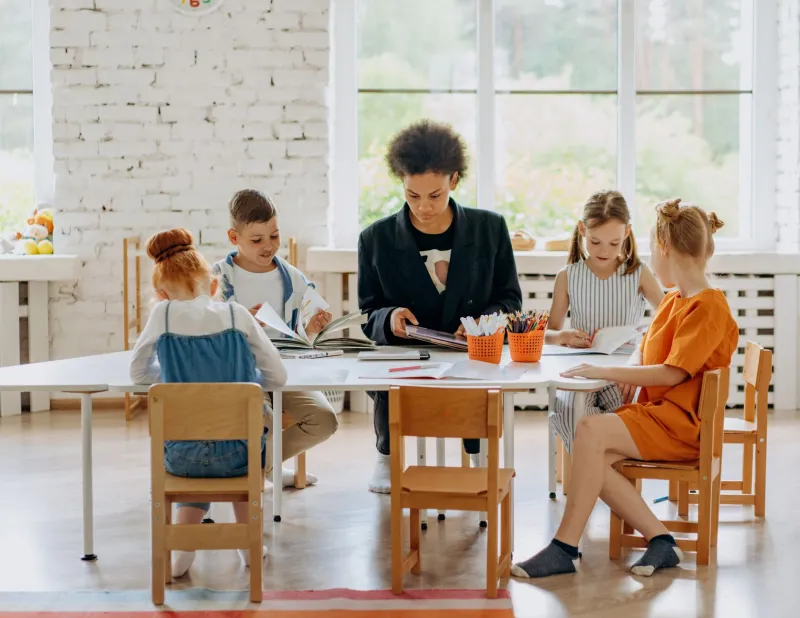
Homeschool cooperatives operate on a related but distinct model. Families who have chosen to educate their children outside conventional schools pool their resources, expertise, and time to create shared learning environments. One parent with a background in mathematics may lead a weekly class for a cohort of children while another with skills in woodworking or ecology contributes in a different register. The collective distributes both the labor of teaching and the cost of materials, making rigorous home education viable for families who could not sustain it alone.
The Governance Question
What distinguishes cooperative schools from simply "involved parent" schools is the nature of the authority being shared. In most conventional schools, parent engagement is welcomed within clearly circumscribed limits. Parents may volunteer in classrooms, fundraise, and attend informational sessions — but they do not set policy, evaluate teachers, or determine how resources are allocated. The cooperative model treats these boundaries as a problem rather than a feature.
At Cottonwood School of Civics and Science in Oakland, California, for instance, a fully democratic governance structure places parents and staff on equal footing in school-wide decision-making. The school has operated continuously for decades on this basis, and its participants describe the model not merely as an administrative arrangement but as a form of civic education in itself — children growing up in an institution that models collective problem-solving and shared responsibility tend to internalize those values in ways that no civics textbook can replicate.
This is a point cooperative school advocates return to consistently: the structure of an institution teaches as powerfully as its curriculum. A school where adults model democratic deliberation, honest disagreement, and collective accountability is delivering a lesson every single day, regardless of what subject is formally on the schedule.
Affordability as a Cooperative Outcome
The financial dimension of cooperative schooling deserves serious attention, particularly in an era when the cost of both private schooling and supplemental education has become prohibitive for working- and middle-class families. Because cooperative schools distribute operational labor among their members, they are able to reduce the overhead that drives costs in conventionally administered institutions. Families contribute their time in lieu of fees that would otherwise pay for services the community can provide itself.
Homeschool cooperatives achieve similar results through resource pooling. A group of ten families sharing the cost of science lab supplies, field trip transportation, and shared curriculum materials faces a dramatically different financial reality than any single family attempting to replicate those resources independently. The collective makes possible what the individual cannot sustain.
For communities that have historically been underserved by public schools — whether due to geographic isolation, cultural misrepresentation in standardized curricula, or chronic underfunding — the cooperative model offers something beyond affordability. It offers agency. When a community governs its own school, it can ensure that the history, language, values, and knowledge systems of that community are not treated as supplemental additions to a default curriculum but as the foundation from which all learning proceeds.
Challenges That Demand Honest Accounting
Cooperative schools are not without their difficulties, and intellectual honesty requires acknowledging them. The labor-sharing model, while financially beneficial, demands a real commitment of time from participating families — a commitment that is easier to sustain for households with flexible schedules than for those working multiple jobs or managing caregiving responsibilities without support. Poorly designed cooperative structures can inadvertently replicate the inequities they seek to address, concentrating influence among families with the most available time.
Governance by consensus or democratic vote can also be slow, and navigating genuine disagreement among stakeholders requires skills — in facilitation, conflict resolution, and collective deliberation — that most participants have not been formally trained in. The cooperative school movement has learned, sometimes through painful experience, that democratic governance requires deliberate cultivation. It does not emerge automatically from good intentions.
These are not arguments against the model. They are arguments for building it carefully, with attention to the structural conditions that allow genuine participation rather than nominal inclusion.
What the Cooperative School Teaches the Rest of Us
The cooperative school is, at its core, an argument about who education belongs to. The conventional answer — implicit in the architecture of most American school governance — is that education belongs to the state, administered by professionals, delivered to families who are welcome to observe but not to govern. The cooperative answer is different: education belongs to the community that lives it, and the people most affected by its outcomes are precisely the people who should hold authority over its direction.
This is not a radical proposition in the abstract. Most Americans, asked whether parents and teachers should have meaningful say in how schools are run, would answer affirmatively. The cooperative school is simply the institutional form that takes that answer seriously — that builds structures capable of honoring it rather than merely invoking it as a rhetorical gesture.
In a nation where trust in institutions is eroding rapidly and the hunger for genuine agency is palpable across the political spectrum, the cooperative school offers something rare: a model that does not ask people to trust a distant authority, but invites them to become the authority themselves. That invitation, extended seriously and structured carefully, is one of the more hopeful things happening in American education today.